The Anne Frank House – more than a museum
The organisation
The Anne Frank House is a non-profit organisation. Its main aims are to administer the Anne Frank House museum and to spread the message of Anne Frank’s life and ideals. The Anne Frank House is an independent organisation with no affiliations to any political party or ideological movement.
Annual Report 2012
The Annual Report of the Anne Frank House with an overview of the activities in 2012.
To the Annual Report 2012
Stories from the classroom
We would like to her about your experiences. Share them on our new Teachers’ portal site.
More...
Partners
Thanks to our international partners, our educational products and projects can be found all over the world.
More...
The beginning
The Anne Frank House was founded on 3 May 1957 with the primary aims of preserving the Anne Frank House and spreading the message of Anne Frank’s life and ideals. Following a fundraising drive, restoration work began in 1958, and the Anne Frank House was officially opened as a museum on 3 May 1960.
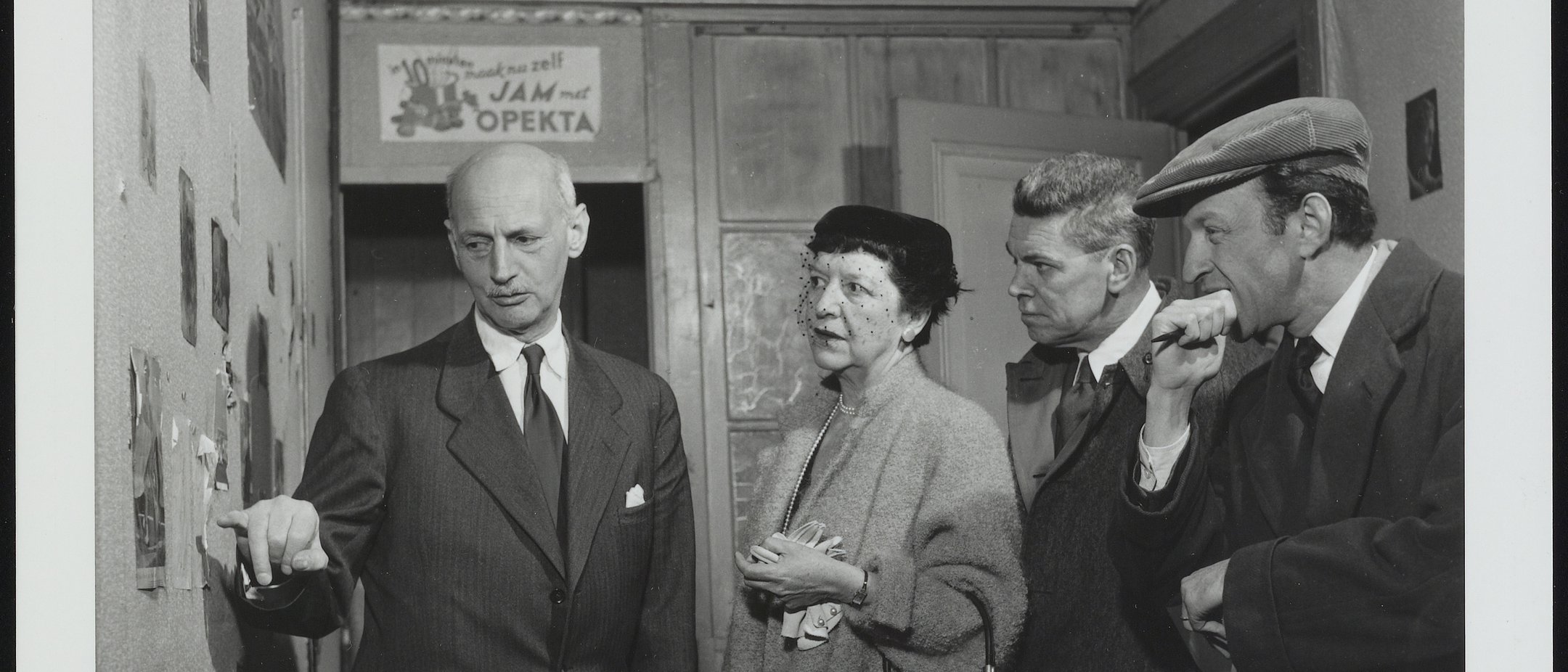
Otto Frank with the first board members of the Anne Frank House in 1957. From left to right: Floris Bakels, Otto Frank, Truus Wijsmuller and Herman Heldring.
Otto Frank
After the opening of the Anne Frank House, the neighbouring building at Prinsengracht 265 was expanded. The first international youth conference was held here in May 1961, with the theme ‘How can young people contribute to better mutual understanding in the world?’. Many conferences, lectures and other events were organised throughout the 1960s, often with the participation of Otto Frank.
An international youth conference at the Anne Frank House in 1966, with Otto Frank and his wife Fritzi in the front row.
Our mission
The Anne Frank House is an independent organisation entrusted with the care of the Secret Annexe, the place where Anne Frank went into hiding during World War II and where she wrote her diary. It brings her life story to the attention of people all over the world to encourage them to reflect on the dangers of anti-Semitism, racism and discrimination and the importance of freedom, equal rights and democracy.
Strategic Aims
On the basis of the Anne Frank House’s mission, the following aims have been formulated for the period up to 2015:
- The opening of the Anne Frank House to the public, and the care of its collections;
- The development and distribution of programmes and materials in which the life story of Anne Frank is disseminated, partly in the historical context of the Second World War and the Holocaust;
- The provision of information and education on anti-Semitism and the persecution of the Jews;
- The provision of information and education on discrimination and socio-political human rights, in order to promote the effective functioning of an open, pluralistic and democratic society.
Activities
In addition to the preservation, care and display of the collection and the opening of the museum to the public, the Anne Frank House has two other main tasks: public information and education. The organisation develops programmes and products in which the life story of Anne Frank is told in the context of the Second World War and the persecution of the Jews. The Anne Frank House does not only wish to inform its target group, but also to meet with them, enter into dialogue with them, and inspire and motivate them to reflection and action.
Based on the strategic aims, four themes have been formulated that serve as a framework for the Anne Frank House’s activities in the period 2012-2015:
1. Anti-Semitism;
Anti-Semitism has existed throughout history. The life story of Anne Frank cannot be understood without a knowledge of the history of anti-Semitism. By providing information and education on anti-Semitism, the Anne Frank House actively contributes to combating it.
2. Equal rights;
The principle of equal rights and the prohibition of discrimination form fundamental principles of our legal order. The process of unequal treatment and the denial of human rights are central issues in the life story of Anne Frank. Because of this the principle of equal rights forms a key theme in the accomplishment of the organisation’s mission.
3. Identity/prejudice/perception;
Identity plays a major role in the thought process that lies at the basis of anti-Semitism and discrimination. Awareness of the positive and negative aspects of identity can contribute to better relations between individuals and groups of citizens in a pluralistic society.
4. Citizenship;
Active citizenship, in which citizens feel responsible for and actively involved in the society in which they live, forms a defensive wall against prejudice, exclusion and extremism, and contributes to a strong democracy.
The Anne Frank House publishes an annual report listing its most important activities of the previous year: Annual report 2012.
Management
The Directors are responsible for the management of the Anne Frank House. They are appointed by the Supervisory Board, which supervises the policy of the Directors and provides them with advice. In addition to the Supervisory Board the Anne Frank House also has an Advisory Board, made up of representatives of various sections of society. The Advisory Board advises the Supervisory Board on issues that are definitive for the identity of the Anne Frank House. In effect the Advisory Board acts as a ‘sounding board of society’.
Finance
The Anne Frank House is mainly dependent on museum visits for its income: revenues generated by the museum cover more than ninety-five percent of the annual budget. For the financing of its other large projects the Anne Frank House relies on finance from a variety of funds, collaborating partners, friends and donors, or subsidies from the European Union and the Dutch government.