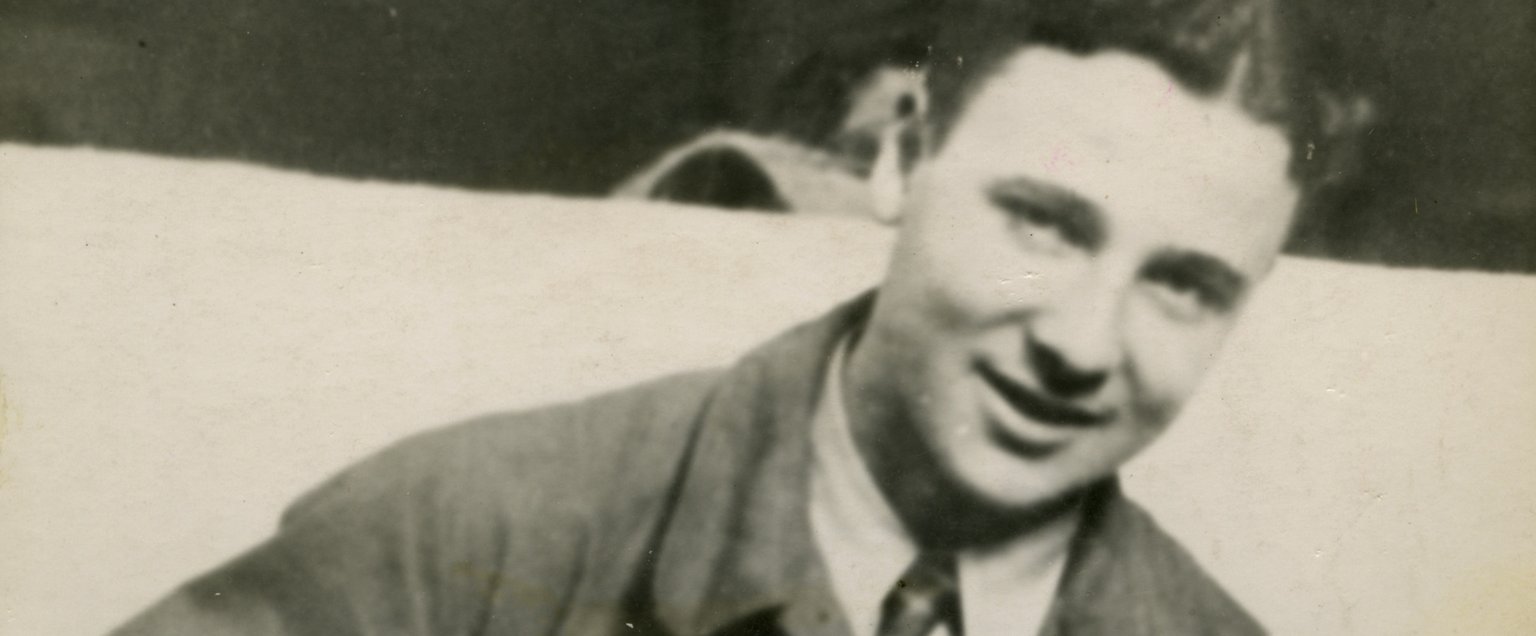
What is known about Peter comes mainly from Anne’s diary.
Peter van Pels was born on 8 November 1926 in Osnabrück, Germany, the only child of Hermann van Pels and Auguste van Pels-Röttgen. In 1937, Peter fled to Amsterdam with his parents. Being Jewish had become dangerous in Nazi Germany. Five years later, Jews were no longer safe in the Netherlands either. On 13 July 1942, the Van Pels family went into hiding in the Annex, part of the business premises of Anne’s father at Prinsengracht 263, where the Frank family had been in hiding since 6 July. Peter’s father, Hermann, worked for Anne’s father, Otto. Peter brought his cat Mouschi with him to the hiding place, much to Anne’s indignation, as she had to leave her beloved cat Moortje behind.
Falling in love
Anne regularly wrote about Peter in her diary. At first, she considered the boy, who was more than two years older than her, a “boring and shy klutz”, but they later became good friends. According to Anne, Peter studied English, French, Dutch, English and German shorthand, English commercial correspondence, woodworking and economics, and sometimes arithmetic and geography. He also developed a passion for crossword puzzles. Peter did all kinds of odd jobs in the Annex and shared responsibility for security.
In early 1944, a brief romantic relationship developed between Anne and Peter. Anne found Peter handsome (“His hair is wonderful: a thick, brown mass of curls. Blue-grey eyes.”) and longed for his company. Before long, however, Anne realised that Peter was not the one for her. On 19 May 1944, she wrote: “After my difficult conquest, I am somewhat above the situation, but you mustn’t think that my love has faded. He is a darling, but I have quickly closed off my inner self again.”
Arrest and deportation
On 4 August 1944, the Nazis arrested the eight people in hiding in the Annex. A few days later, they were taken to the Westerbork transit camp. According to a fellow prisoner, Anne and Peter spent a great deal of time together there. On 3 September 1944, they were deported to Auschwitz. On the platform at the Auschwitz-Birkenau concentration and extermination camp, the men and women were separated. Peter and Anne saw each other for the last time. In October, Peter’s father, Hermann, was murdered in one of the gas chambers. Otto Frank took Peter under his wing, and Peter also supported Otto. Otto later stated: “Peter helped me like a son. Every day he brought me extra food.” As the Soviet army approached and the Nazis evacuated Auschwitz, Peter joined one of the death marches. Otto remained behind in the sick barracks and was the only one of the eight people in hiding in the Annex to survive the war.
Only 18 years old
After eight days, Peter arrived at Mauthausen concentration camp on 25 January 1945. A few days later, he was transferred to the Melk subcamp. There, he was forced to perform labour on the construction of an underground factory. The living and working conditions were inhumane, and the death rate was high. In April 1945, Peter was returned to Mauthausen, seriously ill. According to a list kept by the medical staff, Peter van Pels died on 10 May 1945, five days after the camp was liberated by the US Army. He was only 18 years old.